Understanding your imaging report
Understanding BI-RADS Reports
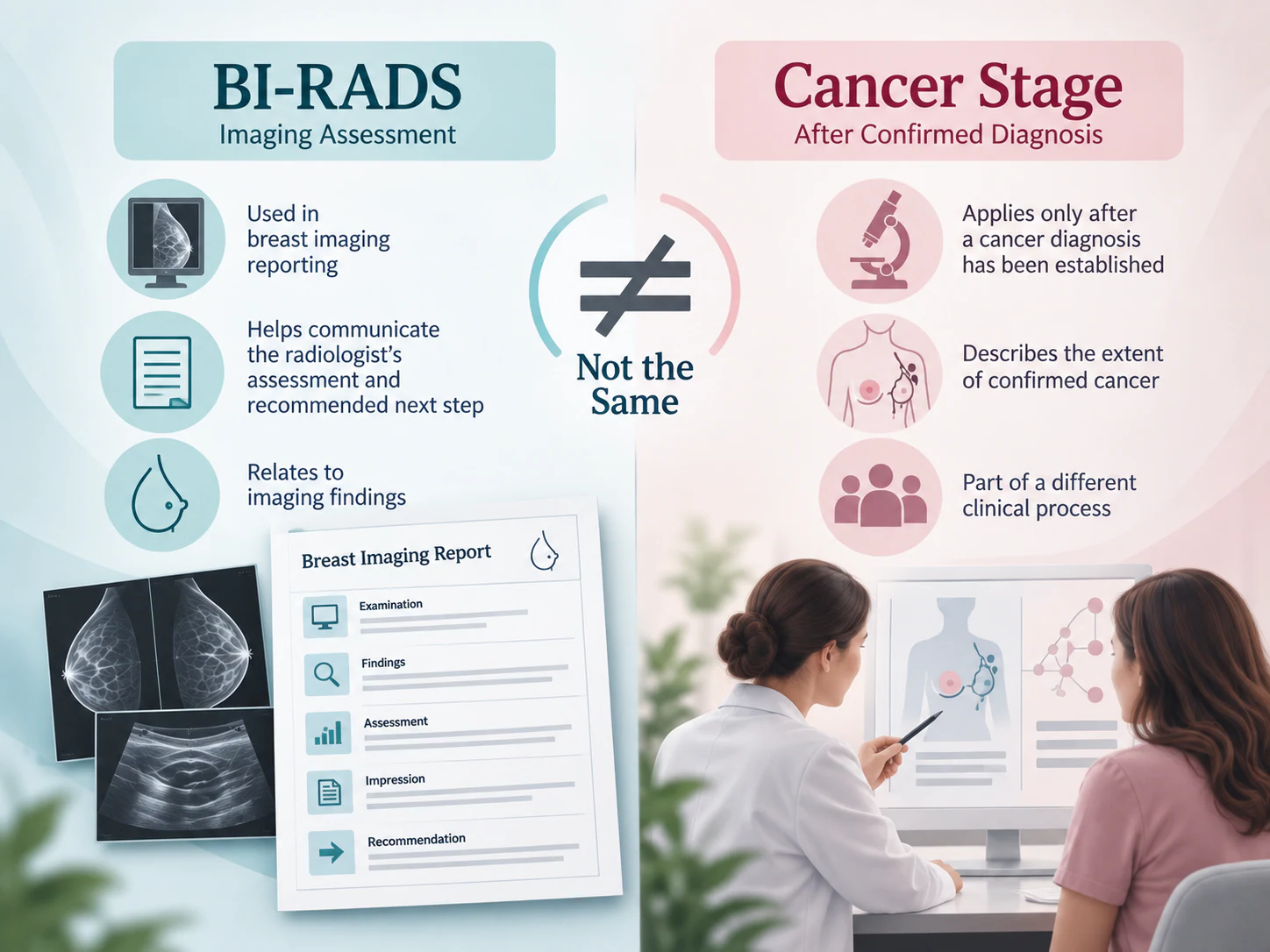
BI-RADS is the assessment category used in breast imaging reports. It helps explain what the radiologist found and what should happen next. It is not a cancer stage or a diagnosis on its own. Read the category together with the full report and your clinician’s advice.
Contact the practice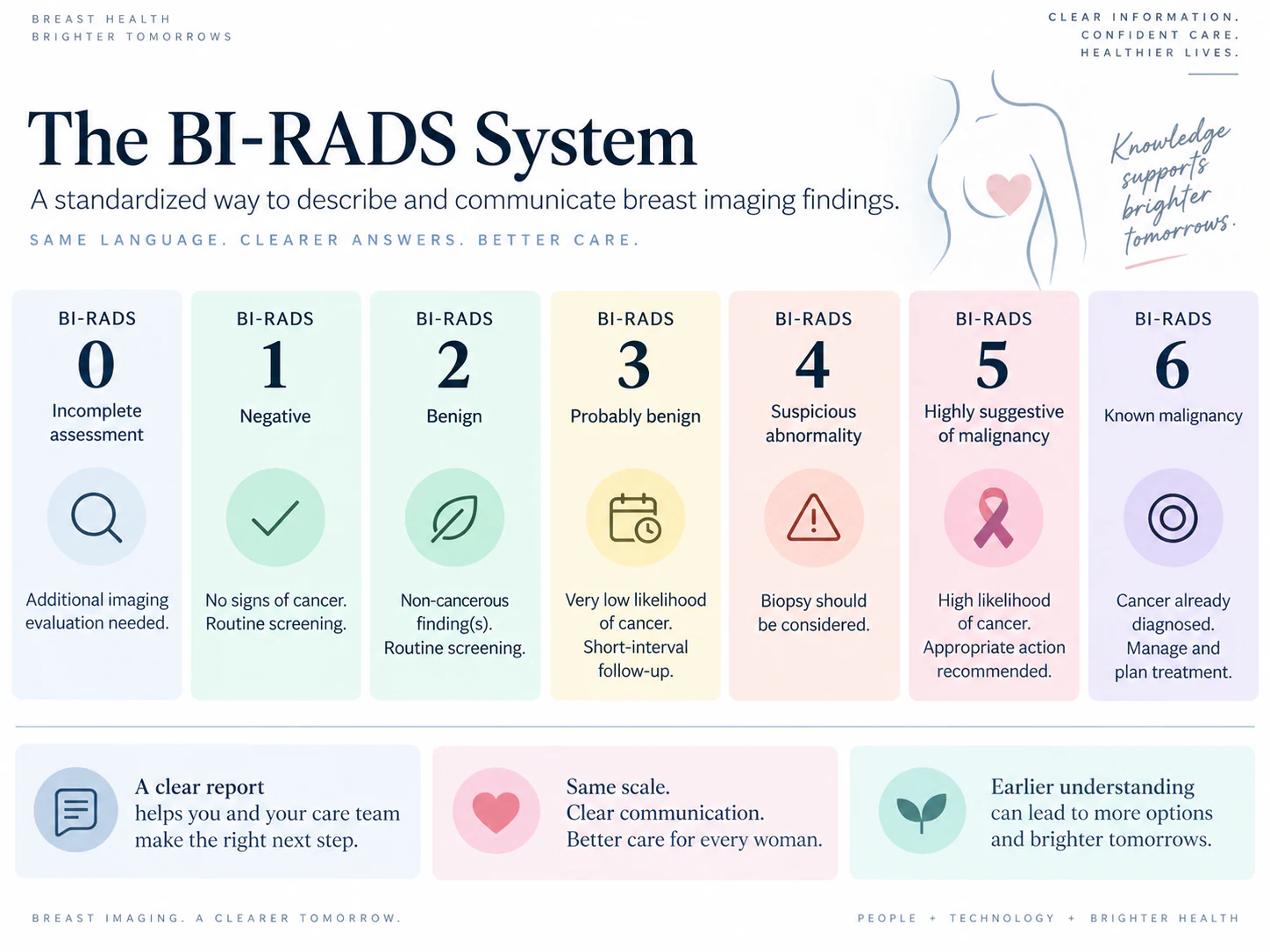
A shared language for breast imaging
BI-RADS stands for Breast Imaging Reporting and Data System, developed by the American College of Radiology. It gives breast imaging reports a consistent way to describe findings and recommend a next step.
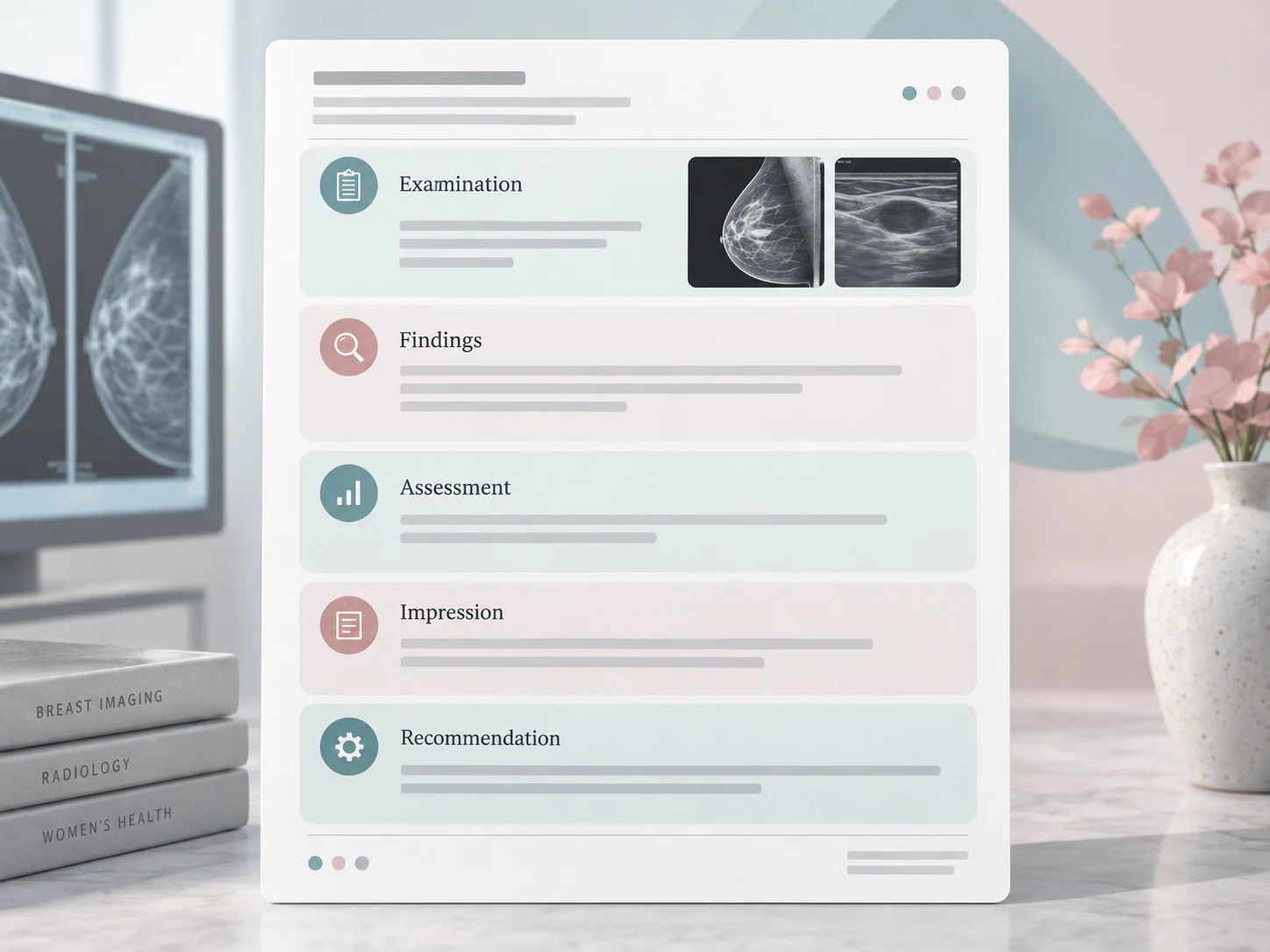
Read the category with the report’s description, comparison with earlier studies and recommendation. The number alone does not explain the full assessment.
The assessment categories
These brief explanations describe the categories in general terms. Follow the recommendation in your report and discuss the timing with your clinician.
| Category | Meaning | What usually happens next |
|---|---|---|
| 0 | Incomplete assessment | More imaging and/or comparison with earlier mammograms is needed. |
| 1 | Negative | No suspicious imaging finding; screening advice depends on the clinical context. |
| 2 | Benign finding | A non-cancerous imaging finding; follow the screening recommendation. |
| 3 | Probably benign | A finding with a very low likelihood of cancer; a shorter follow-up interval is generally advised. |
| 4 | Suspicious | Sampling is generally recommended to establish the diagnosis. Subcategories 4A, 4B and 4C express increasing levels of suspicion. |
| 5 | Highly suggestive of malignancy | Prompt further management, usually including tissue diagnosis, is needed. |
| 6 | Known biopsy-proven malignancy | Cancer has already been established by biopsy; imaging helps the treating team manage care. |
A category is not a cancer stage
BI-RADS communicates the imaging assessment. Cancer staging describes the extent of a diagnosed cancer using additional clinical and test information. The numbers belong to different systems.
For example, BI-RADS 4 does not mean stage 4 cancer. A suspicious imaging finding needs the recommended assessment; the category alone does not establish a cancer diagnosis.
Focus on the recommended next step
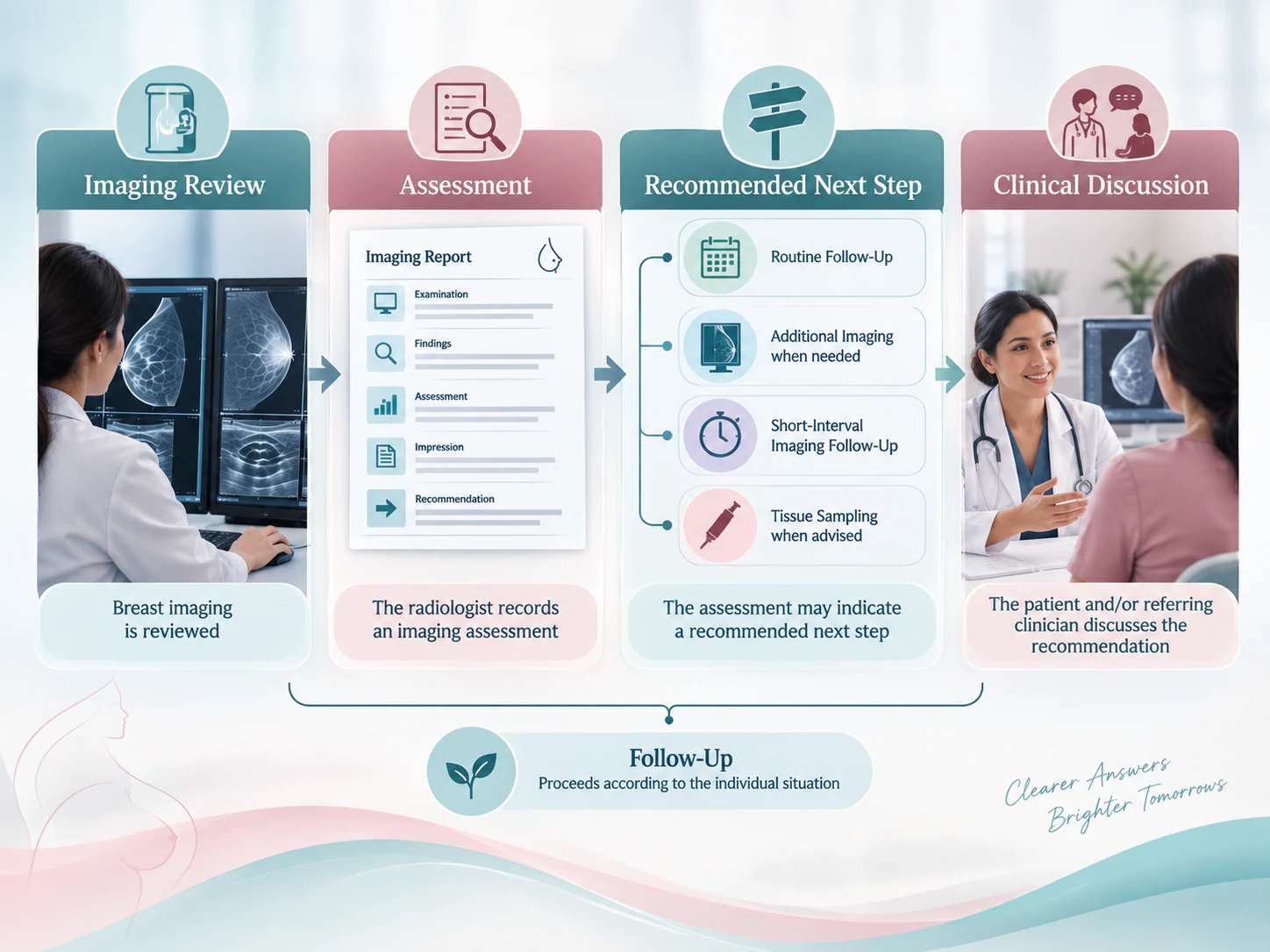
The recommendation may involve comparison with earlier studies, further imaging, follow-up or sampling. Ask what needs to happen next, when it should happen and who will arrange it.
Tell your clinician about a persistent or changing symptom even if an imaging report describes a negative or benign result. Your symptoms, examination and imaging need to be considered together.
Questions to discuss with your clinician
Bring the complete report and available images to the discussion. An online category list cannot determine which recommendation applies to you.
- What does the assessment mean in the context of my symptoms and earlier studies?
- Is more imaging or a previous examination needed for comparison?
- What next step is recommended, and within what timeframe?
- Who should I contact if I cannot arrange the recommended follow-up?
Common questions
Does BI-RADS 0 mean cancer?
No. It means the imaging assessment is incomplete and further imaging or comparison is needed. Arrange the next step described in the report.
Is BI-RADS 3 the same as stage 3?
No. BI-RADS describes an imaging assessment, while cancer stage describes the extent of a diagnosed cancer. They are different systems.
Can this guide tell me whether I need a biopsy?
No. Your clinician needs the full report, clinical findings and relevant history to discuss the recommended next step with you.
Does BI-RADS 3 mean I need a biopsy?
BI-RADS 3 usually leads to an imaging follow-up plan. Follow the interval in your report and discuss any new symptom with your clinician rather than waiting.
What happens after BI-RADS 4 or 5?
These categories generally lead to a recommendation for tissue sampling. They are imaging assessments, not a diagnosis from a tissue sample. Ask your clinician to explain the recommended biopsy and timing.
Bring the whole report to the discussion
Ask the treating team to explain the recommendation and help you arrange the next appointment. Do not use the category alone to make treatment decisions.
Contact the practice